

Conversations With A Monk — Chapter 1: When Success Feels Empty
A series exploring timeless wisdom for modern life

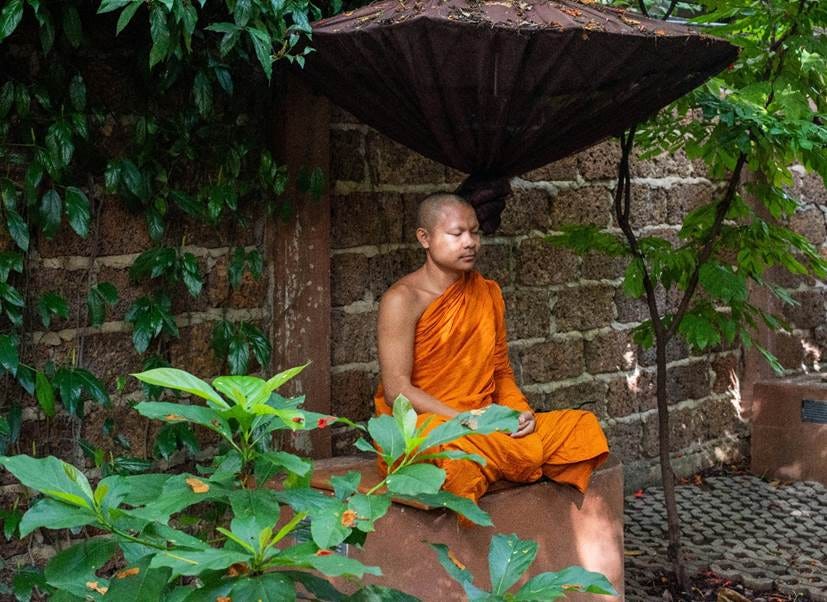
At forty-three, Aryan had most of the things people aspire to and equate success with. Over two decades in the corporate world, he had climbed from a junior analyst to a senior leadership rank at a multinational firm. Along the way, he had earned industry awards, handsome bonuses, and the respect of colleagues. He owned an elegant bungalow, a luxury car, had an impressive investment portfolio, and memberships to select clubs. At home, a loving wife and a six-year-old son completed the portrait of his nearly-perfect life.
Yet, beneath the polished exterior, the financial security, and all the professional achievements lay a restless, unhappy man. A persisting emptiness followed his busy, frenzied days, lingering even in moments that should have brought joy. When he sat with himself after the day, he would wonder why there was no peace or contentment.
One evening, as he had almost slept on his lounge chair, his phone rang. It was his childhood friend, Akshar, from the neighborhood. He excitedly told him that an accomplished monk known to his father, was scheduled to visit their house on the coming weekend. He invited Aryan to come and receive his blessings.
Aryan had never met a monk before and immediately accepted the invitation.
On the appointed Saturday, he joined a swarm of people gathered in the front garden of Akshar’s bungalow; a peaceful and radiant monk seated on a stone pedestal in front of them. The monk was replying to questions from the audience with gentleness, care and Wisdom. To a careworn middle-aged man, he said, “You have built a successful life, but have you built a meaningful one?” Saying so, he looked straight in Aryan’s direction.
Aryan responded like a man jolted from a deep sleep. Was the monk speaking directly to him? Did he know something about him and his life? A sense of disbelief and awe washed over him. He waited for the crowds to thin out before approaching him.
Aryan introduced himself and confided in the monk that in spite of a long, successful career, he did not feel happy, fulfilled, or at peace.
He said: “I have grown up believing that success brings meaning.”
The monk smiled at him gently and affectionately.
“Success can bring comfort; it can open up opportunities and bring respect. But it cannot guarantee meaning. Meaning is something you have to find along the way, else, you will be perpetually discontented.”
Aryan pondered on that deeply.
“But everyone I see around me is chasing success. It seems to be deeply ingrained in us.”
“You are right,” said the monk. “The world teaches you to count what can be measured—your salary, your possessions, titles, even followers. But the things that nourish the human spirit, they cannot be counted so easily. It is your Spirit that brings meaning to life, and to your work as well.”
“Have you been running too hard and too fast, forgetting to nurture your Spirit; without even stopping to ask who it is who is running?”
The monk’s Wisdom forced him to reflect. He looked puzzled.
“What do you mean?”
“You know your work, your achievements, your goals and ambitions. But do you know yourself?”
The question unsettled him.
“I thought I did,” he replied.
“A man may conquer a thousand mountains and still be defeated by his own restlessness.”
Aryan lowered his gaze. “That sounds like me.”
The monk nodded gently.
“When you start living from the authenticity of your True Nature, you will find both happiness and fulfilment,” he smiled.
“Contentment at work does not come from always asking: “What am I getting?” but instead, from posing the question: “What am I contributing, becoming and learning?”
“If you can connect your work to a larger purpose, align it with your personal values, view your role as an opportunity to solve problems and help others, and see work as a part of your growth, then success will never feel empty again.”
“Remember, achievement is not the same as meaning. Lasting meaning comes from purpose, growth and contribution,” he completed.
Aryan was listening with undivided attention and awe, wondering, at the same time, how the monk could provide such deep insights on practical life.
“Let me take you thousands of years back to a compelling story from the Upanishads,” the monk continued. “This is a dialogue between the renowned sage Yajnavalkya and his wife Maitreyi. Till today, it stands as one of the most profound conversations in all of Indian philosophy.”
“One day, Yajnavalkya decided it was time to renounce worldly life and devote himself fully to spiritual realization.
Before leaving, he summoned one of his two wives, Maitreyi, and expressed his desire to divide his property between the two and quietly leave. For most, this would seem like a generous offer. But Maitreyi asked him a pertinent question:
“If the wealth of the entire world would become mine, would I gain immortality through it?”
The sage replied: “Your life would become very comfortable, like that of wealthy people, but there is no hope of immortality through wealth.”
That was a pivotal moment for Maitreyi. She realized that wealth can provide comfort, status, security, and pleasure, but cannot solve the deeper problem of human existence. It cannot eliminate fear, loss, aging, death, or inner emptiness.
So, she said: “Then what am I to do with that thing which is not going to make me immortal or permanently satisfied? Teach me instead your Wisdom.”
She rejected inheritance for Wisdom.
Sage Yajnavalkya then began his teaching:
“It is not for the sake of the husband that the husband is loved, but for the sake of the Self.”
“It is not for the sake of the wife that the wife is loved, but for the sake of the Self.”
He continued:
“Not for the sake of children...”
“Not for the sake of wealth...”
“Not for the sake of the world...”
“Not for the sake of Gods...”
“Not for the sake of the beings...”
“At first, this may sound like a strange teaching, and perhaps selfish, for he says that the Self alone is dear. Hence, our love for other objects is secondary, leading only towards the joy of the Self.”
“But sage Yajnavalkya is pointing to a very deep truth. He is saying that for every object we love, what we love really is the promise of fulfilment we think it holds, or the completeness of being we think we will achieve.”
“He means that every desire is really a search for wholeness and completeness. And that fulfilment can be found only in the inner Self, where we are already complete, whole and blissful.”
“We tend to believe that completeness will be found in external possessions or achievements. We search for it in the next promotion, the next car, the right partner, more money, etc.”
“The object keeps changing, but the underlying longing remains the same. Ultimately, this longing is to know and experience our own deepest Self.”
“Therefore, Aryan, today you feel restless and dissatisfied, not because of a lack of achievement, or because your desires are wrong, but because you are searching for fulfilment in goalposts which cannot provide it permanently.”
“Stop mistaking your outer accomplishments as a source of lasting fulfilment; and seek instead your inner completeness, your true Self. Then let everything you do become an expression of that. Infuse everything you do with the energy of Spirit within.”
“When you do the same things with a different intention and perspective, you will notice a subtle shift in how you are feeling,” the monk observed with clarity.
Aryan was struck by the deep Wisdom. Why had he never stopped to ponder on this? He wondered.
“How can the Self be known?” he asked.
The monk smiled: “The Self must be heard about, reflected upon, deeply contemplated and realized directly. This is what sage Yajnavalkya told next, to Maitreyi.”
“Every day, give some time to yourself, away from all distractions, goals and needs. Learn to sit silently with yourself. This is not an outward quest, but an inner pilgrimage.”
The conversation paused here. The lesson did not.
Until next time, sit with this question:
“What gives your life meaning beyond achievement?”
Thank you enjoyed reading, completely agree wholeness and meaning can't be found externally through seeking external validation, accomplishments, possessions etc. Loved the story within the story and learning from the Upanishad!
Beautifully written Isha.
"You know your work, your achievements, your goals and ambitions. But do you know yourself?"
That line stayed with me long after I finished reading. Perhaps one of the biggest life lessons we are all here to learn.